

Food, Seeds, Solidarity and Stories
We explore food as commons in conversation with Broudou School collective's member and SoC 26' alumn* Cyrine Ghrissi.

We started our conversation ONLINE


We CONTINUED a conversation with Cyrine of Broudou school Asynchronously...

.png)


Broudou School brings focus to community-oriented, life-embedded practice of work with both material culture, the everyday and the community with the relational space at the core. It also speaks to situated pedagogy which makes one think of institutions, it encompasses political reality that makes us consider the role of material culture in oppressive and extractive forms
The collective includes Aziza Gorgi, Cyrine Ghrissi, Emily Sarsam, Mary Sarsam, Raouia Briki, and Sarra Bouzgarrou. But the School is also shaped by the communities, farmers, researchers, artists, and participants who enter these processes with them.

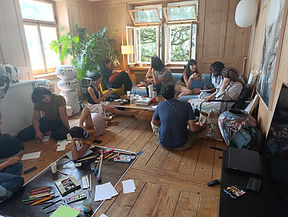
During our online conversation.. Cyrine brought topics in relation to publishing and sharing information, seeds and younger generations, histories and traumas that other related to stories connected to foods, and also, with the School of Commons' program—we spoke about the notion of commons, about sharing recipes from different not-related and not-linked contexts as part of the SoC and what it means to view “commons” from all of these complex angles.


We asked Cyrine: What role does art play in your research on commoning related to food and knowledge
Where does it intersect with, support, or conflict with community work?
Cyrine responded:
Art allows us to approach questions that cannot always be addressed through conventional research or political language.
Within Broudou, artistic practice is part of how we research, communicate, gather, and learn. Food, plants, recipes, seeds, landscapes, gestures, and collective rituals become materials through which we can think together.
There can also be tensions. Art can romanticise, aestheticise, or appropriate community knowledge, so we have to remain conscious of that.
The question for us is therefore not simply how art can represent a community, but how artistic methods can create spaces for people to participate, exchange, experiment, and produce knowledge together. This happens through workshops, publications, zines, recipes, poems, images, and collective gatherings where personal stories, ingredients, seeds, memories, and sometimes grief can meet.
on ART, FOOD and KNOWLEDGE
~~~~~~~~~~~~~~........
.png)
We asked Cyrine: How do artistic methods create forms of knowledge that conventional research or education often cannot?
Cyrine responded:
Artistic methods make knowledge embodied.
Instead of only reading or talking about food systems, we can walk through a landscape, touch plants, collect seeds, cook, taste, listen to stories, or reconstruct a recipe. These actions create another form of understanding.
They also allow knowledge to remain open. A workshop or collective meal does not necessarily produce one answer; it can produce questions, relationships, memories, gestures, and curiosity.
Learning does not always happen through instruction. Sometimes it happens through doing, observing, exchanging, and making mistakes together.
.png)
Throughout the Broudou School, collective food practices have often shifted food from being understood as a commodity into something relational.
When people gather around plants, seeds, recipes, harvesting, or cooking, food becomes connected to memory, territory, labour, and relationships.
The collective process itself becomes part of the learning. People are not only learning about a plant or recipe; they are learning from one another.
Photo collab with Rashad Yusifov
.jpg)
.jpg)
ON SEEDS
Seeds are not simply biological matter.
They are part of social worlds.
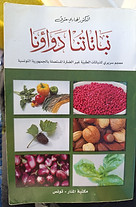
THE PUBLICATION about Food, Plants and Shared Relational Space


We asked Cyrine: What does the publication reflecting the School of Commons year aim to preserve or communicate?
Cyrine responded:
The publication is an attempt to preserve the learning of the year, but not simply as an archive of events.
I would like to communicate the relationships, questions, recipes, plants, stories, and forms of knowledge that emerged through the School.
Food becomes a way of bringing these different dimensions together: ecological knowledge, social relationships, memory, politics, artistic research, and collective learning.
The publication becomes another space through which the food, knowledge, and relationships developed during the project can continue to move.
We asked Cyrine: The publication includes wild plants, spontaneous plants, and collective recipes. How did these themes emerge?
Cyrine responded:
These themes emerged from a personal relationship with the Sejoumi wetland, near where I live in Tunis. Through working around its preservation, I became fascinated by its beauty and by the plants and water systems I was discovering.
As an urban resident, I was also always intrigued by spontaneous plants growing around old and abandoned buildings. Conversations with artists and biologists helped me look at these plants differently—not simply as weeds, but as part of urban ecosystems and forms of ecological knowledge.
This led to think about food not as an isolated resource, but as a relationship between people, plants, landscapes, memory, and changing environments.
Seeds carry stories through relationships.
.png)
.png)
Cyrine told us that...
The Wetlands Recipes workshop at the School of Commons developed this further. Participants remembered wetlands, mapped them, identified plants, and created recipes based on one plant and their own food traditions. The recipes became ways of connecting ecological knowledge with cultural memory.
Flavor in the Anthropocene approached the recipe from another direction, asking participants to imagine how a disappearing flavour might be recreated in a changing future.
Together, these projects made us think of recipes as both archives of memory and tools for imagining the future.
The idea of “resistance plants” also emerged during a field visit with Graines de Bonheur. While walking and talking about wild plants, we began imagining falfoul—small, colourful jelly sweets for children made from wild or, as they preferred to call them, naturally spontaneous plants. It is still an evolving idea, but it reflects our interest in transforming how we perceive and relate to these plants.


Through the Seed Magazine and online gatherings, including the School of Commons, what conversations emerged across different geographical contexts?
The gatherings opened conversations around food sovereignty, seeds, memory, ecological change, and the future of food.
Seed Season brought together the Iraqi Seed Collective, Palestine Heirloom Seed Library, Graines de Bonheur in Tunisia, and Salt Spring Seed Sanctuary Society in Canada. Their contexts were very different, but they shared questions around diasporic seeds, community seed saving, ecological knowledge, and the effects of displacement, war, and climate change on food systems.
One important conversation was around diasporic seeds. Seeds can travel with displaced people and become carriers of memory and connection to land. A community may lose access to its territory while maintaining a relationship with it through seeds, recipes, agricultural practices, and culinary traditions.
We also questioned what it means to preserve a seed. Institutional seed banks preserve genetic material, but our conversations focused on living forms of preservation: farmers growing and saving seeds, communities creating seed libraries, people exchanging seeds, and cooks maintaining related food practices.
There is a difference between storing a seed and keeping a seed alive. A seed needs to be grown, cared for, exchanged, understood, and connected to a living community.
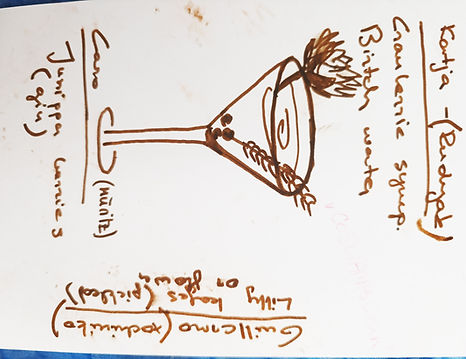
The Flavor in the Anthropocene workshop at the School of Commons approached similar questions through taste and imagination. Participants imagined a favourite food disappearing because of climate change, ecological collapse, water scarcity, or species loss. They then worked collectively to recreate its flavour using future, resilient, or imagined ingredients.
This shifted the question from only “How do we preserve what we have?” to also “How do we imagine what comes next?”
Food became memory, flavour became knowledge, and recipes became speculative tools. The imagined recipes became part of a Museum of Anthropocene Flavors, an archive of foods that tell stories about a changing planet.
The conversations therefore moved between preservation and imagination, memory and future-making, local knowledge and global ecological change. What connected them was the understanding that food is not simply a resource or commodity; it is a way of remembering, relating, surviving, and imagining.
ABOUT THE THEMES OF PUBLISHING ABOUT Food, Plants and Shared Relational Space
.jpg)
The Flavor in the Anthropocene workshop at the School of Commons approached similar questions through taste and imagination. Participants imagined a favourite food disappearing because of climate change, ecological collapse, water scarcity, or species loss. They then worked collectively to recreate its flavour using future, resilient, or imagined ingredients.
This shifted the question from only “How do we preserve what we have?” to also “How do we imagine what comes next?”
.jpg)

What did the reinterpretation of historical recipes reveal about history, migration, and collective memory?
This intervention was part of Food for Thought, initiated by Al Mouhit in Tunis and curated by Elyes Lariani. Five returning chef participants—Francesca D'amico , Elyes Lariani , Firas Hamden, Sara Alhouni, and Skander Gaha—came together around a collective dinner, each preparing a dish inspired by their memories, cultures, travels, and relationship to food.
The dinner included Pappa al Pomodoro, Golden Sun Rice, Under the Fig Leaf, Msakhen, and Peach, Basil and Olive Oil, bringing together references to Italy, Palestine, Libya, Thai and Tunisia.
What interested us was that these dishes were not treated as fixed representations of national cuisines. They became starting points for thinking about how recipes travel, change, and accumulate meaning.
Pappa al Pomodoro, for example, is associated with Tuscan cucina povera and the transformation of simple ingredients such as stale bread, tomatoes, olive oil, garlic, and basil into a nourishing dish. Its history also reminds us that ingredients we now associate strongly with Italian cuisine have their own histories of movement and exchange.
Msakhen, with its taboon bread, onions, olive oil, sumac, and chicken, is deeply connected to Palestinian agricultural life and the olive harvest. In the dinner, placing it alongside dishes connected to Tunisia, Italy, and Libya created a Mediterranean space that could not be reduced to national borders.
The other dishes were similarly connected to personal memories and experiences.
This is why we think of recipes as living documents rather than fixed historical objects. A recipe changes when it moves. Ingredients become available or disappear, techniques are adapted, and new influences enter.
Food can therefore reveal histories of migration, trade, colonialism, agricultural practices, poverty and abundance, and the movement of people and ingredients.
The dinner also challenged the idea of a “pure” culinary identity. What we call traditional food is often the result of many encounters.
The reinterpretation was therefore not about reproducing historical recipes perfectly. It was about asking what happens when recipes are remembered and cooked now—what remains, what changes, and what new relationships are created.
.png)
.png)
.png)

.jpg)

Building Communities through tangible projects

We asked: What practical advice would you give someone who wants to start a commons-based initiative?
Cyrine responded:
Start by listening and observing.
Spend time with the people and place around you. Walk, ask questions, and understand what already exists. There may already be knowledge, practices, relationships, and resources that can become the foundation of the project.
Do not begin by assuming you need to bring a solution. Instead, look for common values and interests. When working with a community that may not already be thinking about something like seed preservation, for example, it is important first to understand their relationship to food, land, plants, and memory. They may already have practices that they simply do not call “seed preservation.”
Build trust before building the project, and start modestly. A commons initiative can begin with a meal, a walk, a conversation, a garden, a workshop, or an exchange of knowledge.
What matters is creating conditions where people can participate, contribute, and learn from one another.
We asked:How do you move from conversations and shared ideas to tangible collaborative projects?
Cyrine responded:
I think it is important to sustain relationships by developing them into tangible projects, because action is also needed.
The challenge is to turn thoughtful discussion into something that reflects everyone's involvement and contribution. But we should not move too quickly from conversation to a predetermined project. The action should emerge from what has been heard and from the shared interests that develop through the process.
Once there is a common interest, a small experiment can become the first tangible step. From there, the project can grow through repetition, reflection, exchange, and collective decision-making.
For me, the process moves from conversation to shared experience, to action, and then back to reflection. Each stage informs the next.
.png)
We asked: What is the most difficult part of such projects and what is the most delightful?
The difficult part is time.
Cyrine responded:
Building trust, understanding a context, and allowing relationships to develop cannot always be accelerated. There is also the challenge of navigating different expectations, resources, and ways of working while remaining open without losing direction.
The most delightful part is when something unexpected emerges: a conversation, a recipe, a forgotten plant, a shared memory, or a connection between people who might otherwise never have met.
These moments remind us that the project is not only producing an outcome. It is producing relationships and new forms of knowledge.
For us, that is perhaps the most important part of commoning: creating the conditions for people to learn from one another and imagine other ways of being together.

Cyrine is an emerging art curator from Tunis, Tunisia. Her curatorial endeavors focus on integrating various multidisciplinary disciplines in collaboration with local communities to explore and address environmental challenges. Through her dedicated research, she delves into the intricate relationship between humans and nature, shedding light on the distinct position of women within these narratives.
Broudou School collective member
Broudou School
SoC Cohort Member
Tunis, Africa